


Wheat is one of India’s most important food crops and a major pillar of the country’s food security. India harvested wheat from about 32.80 million hectares and produced 117.94 million tonnes in 2024–25, with an average national productivity of 3,595 kg/ha, according to the Government of India’s Agricultural Statistics at a Glance 2024–25.
Among India’s wheat-growing states, Uttar Pradesh is the largest producer, with about 9.60 million hectares under wheat, production of 35.65 million tonnes, and productivity of 3,714 kg/ha in 2024–25. Madhya Pradesh followed with about 7.75 million hectares and 3,163 kg/ha, while Punjab recorded 5,123 kg/ha and Haryana 4,774 kg/ha. Rajasthan, Bihar, and Gujarat are also important wheat-producing states.
Major Wheat-Producing States in India, 2024–25
| State | Wheat Area (million ha) | Production (million tonnes) | Average Yield (kg/ha) | Approx. Yield (q/acre) |
| Uttar Pradesh | 9.6 | 35.65 | 3,714 | 15.03 |
| Madhya Pradesh | 7.75 | 24.51 | 3,163 | 12.8 |
| Punjab | 3.51 | 17.99 | 5,123 | 20.74 |
| Haryana | 2.39 | 11.4 | 4,774 | 19.33 |
| Rajasthan | 3.17 | 11.27 | 3,559 | 14.41 |
| Bihar | 2.29 | 7.19 | 3,145 | 12.73 |
| Gujarat | 1.28 | 3.87 | 3,017 | 12.21 |
| Maharashtra | 1.19 | 2.29 | 1,922 | 7.78 |
| India | 32.8 | 117.94 | 3,595 | 14.56 |
Source: Agricultural Statistics at a Glance 2024–25, Government of India. Acre yield is calculated from kg/ha and is an approximate conversion.
The figures show an important opportunity. India has a very large wheat area, but productivity differs considerably between states. This means that improving crop management, irrigation scheduling, varieties, nutrition, soil health, and other agronomic practices can be important for closing yield gaps.
India in the Global Wheat Scenario: Large Area, But Yield Potential Is Much Higher
India is one of the world’s leading wheat-producing countries. FAOSTAT data for 2024 show that India harvested approximately 31.83 million hectares of wheat, the largest harvested area among countries in that dataset. China harvested about 23.59 million hectares.
In production, China was first in 2024 at about 140 million tonnes, followed by India at approximately 113 million tonnes and Russia at around 83 million tonnes.
However, looking only at production can hide an important issue: productivity per hectare. India’s 2024–25 national wheat yield was approximately 3.60 tonnes/ha. Recent FAOSTAT-based 2024 comparisons show substantially higher wheat yields in several countries, for example, New Zealand recorded about 10.01 tonnes/ha, Ireland about 8.14 tonnes/ha, the United Kingdom about 7.28 tonnes/ha, Germany about 7.08 tonnes/ha, Denmark about 7.04 tonnes/ha, and the Netherlands about 6.97 tonnes/ha.
This does not mean that Indian farmers can simply achieve these national averages by changing one practice. Climate, variety, growing season, soil, farm size, mechanization, fertilizer management, disease pressure, and irrigation conditions are all different. But the comparison clearly demonstrates a substantial productivity gap between India’s average wheat yield and yields in several high-productivity wheat-growing countries.
The question, therefore, is not simply “How can India grow more wheat?” The more useful question is: how can Indian farmers produce more wheat from every hectare while using water, fertilizer, and other inputs more efficiently?
Why Irrigation Timing Matters as Much as Quantity
India possesses many of the fundamental resources required for successful wheat cultivation: extensive fertile agricultural land, diverse soils, irrigation infrastructure, suitable rabi-season temperatures in major wheat belts, experienced farmers, and a strong wheat research and seed-development system.
But high wheat productivity does not depend on soil fertility alone. A wheat crop passes through several stages in which water, nutrients, temperature, and root activity must remain properly synchronized. If irrigation is delayed during an important growth stage, the crop may experience moisture stress precisely when the plant is establishing roots, producing tillers, developing spikes, or filling grains.
This is why modern wheat cultivation should move from simply asking “how much water should I give?” to asking: “when should I irrigate, how much water should I apply, and how uniformly should it reach the crop?”
Research conducted by ICAR-IARI scientists in Central India’s Vertisols found that four irrigations at crown-root initiation, tillering, late jointing, and late flowering produced 5.32 tonnes/ha in the experiment, performing similarly to five irrigations while using irrigation more efficiently than several other schedules (Sharma, Indian Journal of Agronomy).
The exact schedule should always be adjusted according to soil type, weather, crop duration, and available water. But the principle is clear: irrigation timing matters as much as irrigation quantity.
Why Mini-Sprinkler Irrigation Is Important for Wheat
Traditional flood irrigation can deliver a large quantity of water to the field, but the farmer has less control over how uniformly that water is distributed. Water may accumulate in low areas while higher areas remain comparatively dry. In lighter soils, excessive irrigation can also move water beyond the effective root zone.
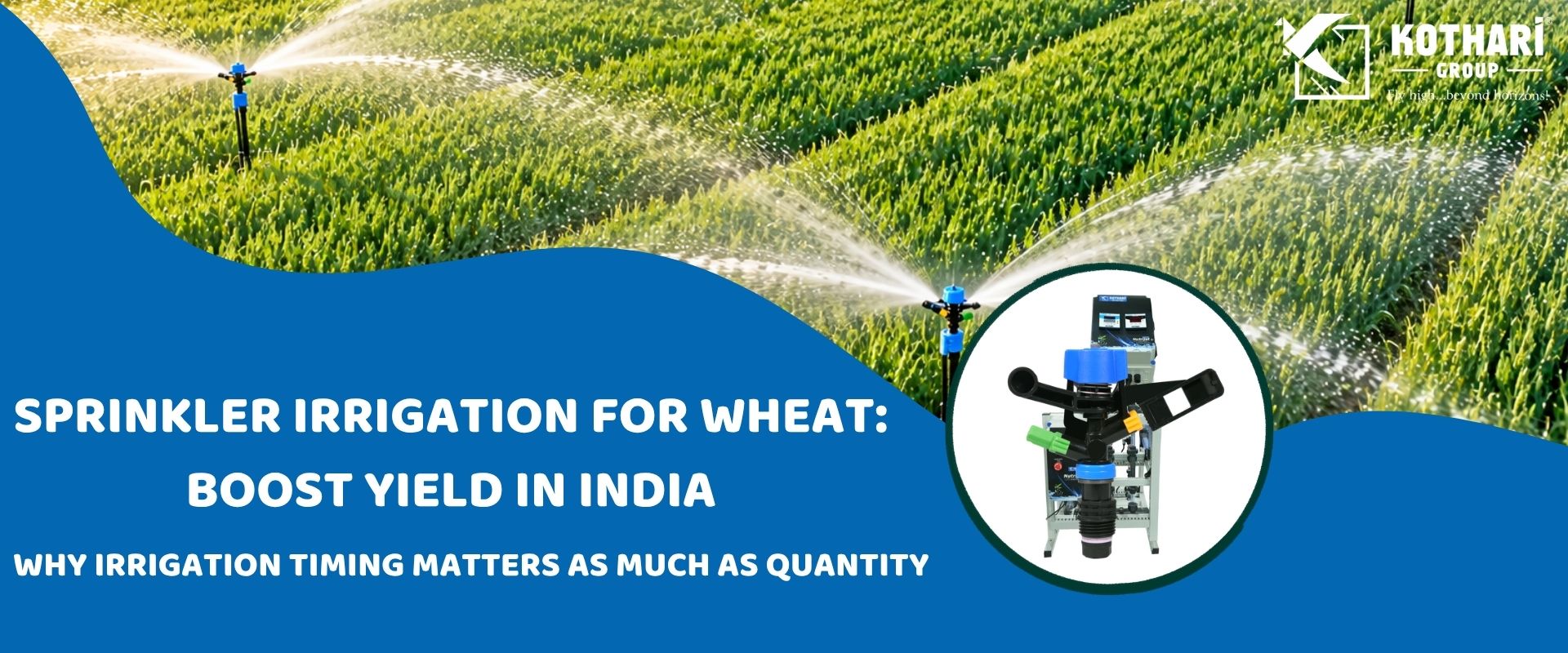
A mini-sprinkler system works differently. It distributes water through sprinklers above the crop, creating an artificial rainfall-like application. Instead of flooding the entire field, water is distributed over the soil surface in controlled droplets, making mini-sprinkler irrigation particularly useful where the objective is to maintain adequate and more uniform soil moisture throughout the wheat crop.
Research from the western Indo-Gangetic Plains on mini-sprinkler irrigation combined with zero tillage and residue mulch has shown meaningful irrigation water savings compared with conventional farmers’ practice, alongside grain yield comparable to surface irrigation and notably higher grain-water productivity and nitrogen-use efficiency. (Note: the exact percentage figure for this study is being reconfirmed with the original source before this claim is finalized.)
A separate field study at Dr. Rajendra Prasad Central Agricultural University, Pusa, Bihar, evaluated mini-sprinkler irrigation in wheat and recorded a wheat yield of 3,547 kg/ha under the tested mini-sprinkler treatment (Journal of Soil and Water Conservation).
These results demonstrate an important point: mini-sprinkler irrigation is not simply about applying less water. It is about applying water more effectively.
Wheat Irrigation: Maintain Moisture From Sowing to Grain Filling
Wheat does not have the same water requirement at every stage. The first priority is good germination and establishment. After that, the crop develops its crown roots and tillers. Later, the crop enters jointing, booting, flowering, and grain-filling stages.
| Wheat Growth Stage | Approximate Timing* | Why Moisture Matters |
| Establishment | Immediately after sowing / early stage | Germination and uniform plant stand |
| Crown Root Initiation (CRI) | ~18–25 DAS | Root development and establishment |
| Tillering | ~35–40 DAS | Development of productive tillers |
| Jointing / Booting | ~50–60 DAS | Spike development |
| Flowering | ~60–70 DAS | Grain-setting potential |
| Milk / Grain filling | ~75–100 DAS | Grain weight and final yield |
Timing varies with variety, sowing date, temperature, and location.
ICAR recommendations and experimental studies consistently identify CRI and other reproductive stages as important periods for irrigation management. A mini-sprinkler system allows the farmer to divide irrigation into smaller, controlled applications rather than depending only on large-volume flood irrigation.
The objective should be to maintain soil moisture within the useful root-zone range, not waterlogging and not moisture stress.
Mini-Sprinkler vs Flood Irrigation in Wheat
| Parameter | Traditional Flood Irrigation | Mini-Sprinkler Irrigation |
| Method | Water flows over the field | Water applied as sprinkler droplets |
| Distribution | Can vary with field level | More uniform when properly designed |
| Control | Relatively coarse | Better control of application |
| Soil moisture management | Large irrigation events | Smaller and more controlled applications possible |
| Waterlogging risk | Higher if excess water is applied | Can be reduced with proper scheduling |
| Field levelling dependence | Higher | Lower |
The actual water saving will depend on soil, field design, sprinkler spacing, operating pressure, wind, irrigation scheduling, and farmer management. Therefore, no single percentage should be assumed for every farm.
Water Management Is the Key to Better Wheat Production
A common mistake is to think that more water means more wheat. It does not. Wheat needs adequate water at the right time. Excess irrigation can reduce aeration in the root zone, increase evaporation and percolation losses, and waste pumping energy. Insufficient irrigation can reduce tillering, spike development, and grain filling.
The best irrigation system is therefore one that allows the farmer to answer three questions:
- When should I irrigate? According to crop growth stage, soil moisture, and weather.
- How much water should I apply? According to soil type, root-zone requirement, and irrigation method.
- Is water reaching the entire field uniformly? According to system design, pressure, sprinkler spacing, and maintenance.
This is where a properly designed mini-sprinkler system becomes a crop-management tool rather than merely an irrigation device.
Kothari Mini-Sprinkler System for Wheat Irrigation
For farmers looking to adopt mini-sprinkler irrigation, system design and water distribution uniformity are critical. A good irrigation system should deliver water consistently across the field, with appropriate pressure, spacing, and discharge.
The Kothari Mini-Sprinkler System is designed to provide controlled and precise water application to the crop. The objective is to deliver water in a rainfall-like pattern across the wheat field while helping farmers manage irrigation according to crop requirements.
For wheat farmers, the value of a mini-sprinkler system is not only the sprinkler itself. The complete system should be considered, from water source and filtration to mainline, sub-main, laterals, operating pressure, sprinkler spacing, and irrigation scheduling. For a broader look at how sprinkler systems compare across different irrigation methods, see our guide to irrigation methods in India.
Kothari’s approach to irrigation is built around efficient water management and delivering the right irrigation solution for the farmer’s field conditions.
How Farmers Can Get Better Results From Mini-Sprinkler Irrigation
Installing a sprinkler system alone does not automatically guarantee higher yield. To obtain the full benefit, farmers should integrate irrigation with complete crop management.
- Select a suitable wheat variety. Choose a variety recommended for the local agro-climatic zone, sowing window, and disease conditions.
- Prepare the soil properly. A good seedbed should provide sufficient soil moisture, good seed-soil contact, and adequate root-zone aeration.
- Maintain a uniform plant population. Correct seed rate, sowing depth, and timely sowing are important for achieving a uniform crop stand.
- Follow soil-test-based nutrition. Nitrogen, phosphorus, potassium, sulphur, and micronutrients should be supplied according to soil condition and crop requirement.
- Give special attention to CRI. The crown-root-initiation stage is one of the most important irrigation stages in wheat. Moisture stress at this stage can seriously affect subsequent crop development.
- Avoid over-irrigation. The objective is not to keep the field continuously wet. Maintain suitable moisture in the root zone without prolonged water stagnation.
- Monitor the system. Check pressure, nozzle condition, filtration, and sprinkler discharge regularly. A blocked or damaged sprinkler can create dry patches and uneven crop growth.
- Irrigate according to weather. Avoid unnecessary irrigation before expected rainfall and adjust the schedule according to temperature, wind, and crop evapotranspiration.
Conclusion: A Practical Step Toward Next-Generation Wheat Farming
India has already demonstrated its ability to produce enormous quantities of wheat. The next challenge is to improve productivity per hectare, water productivity, and input-use efficiency.
India’s 2024–25 average wheat productivity of about 3.60 tonnes/ha is substantially below the productivity recorded in several high-yielding wheat-producing countries. Closing this gap will require more than one technology. Improved varieties, timely sowing, balanced nutrition, soil health, weed and disease management, mechanization, and precision irrigation all have roles to play.
Among these, water management is particularly important because wheat productivity is closely linked to timely availability of soil moisture at critical growth stages. Mini-sprinkler irrigation provides a practical method of delivering water as artificial rainfall, allowing farmers to manage moisture more precisely than conventional flood irrigation under suitable field conditions.
The future of wheat farming is not simply about using more water. It is about using every drop more intelligently.
Want to switch to mini-sprinkler irrigation for your wheat crop? Get in touch with Kothari Group to speak with our team about the right mini-sprinkler system for your field conditions.