


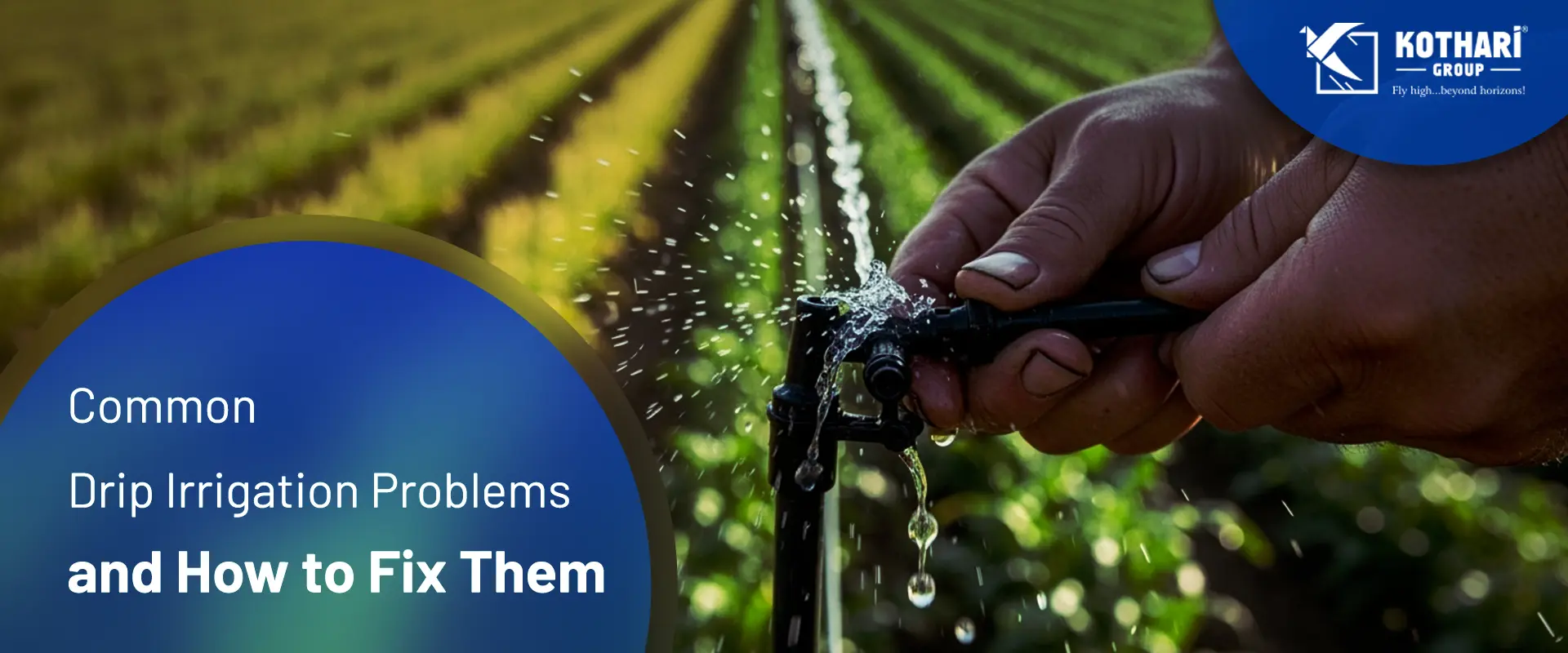
Have you come across patchy fields on your farm? If so, then there might be a leak or a water pressure issue. These issues are common, mainly caused by external factors such as weather and rodents.
If these issues are not addressed in the early phase, they can damage your crops. Hence, this blog will help you address such issues.
Top 5 Drip Irrigation Challanges and Solutions
The issues below are common, and so is handling them. Let’s examine the challanges faced in drip irrigation systems and explore simple solutions.
1. Clogging
Whenever tiny particles of dirt or algae enter the drip irrigation system, the dripper clogs. This reduces or completely stops water flow to the plants and crops. It also affects the pressure of water released from the drippers, which can damage delicate plant parts.
Solution: You can install filters at the water source and regularly flush the system. Select drip irrigation products that feature self-cleaning or anti-clog technology.
2. Leaks and Breaks
Leakages in hoses and the breakage of emitters in a drip irrigation system result in water wastage and increased bills. This challange may not seem significant at first, but over time, the loss occurs on a larger scale. They also affect water pressure across the line, causing poor irrigation in certain parts of the field, which results in patchy fields.
Solution: To prevent this from happening, you should regularly inspect your irrigation system for leaks and breaks. Check for wet patches or sudden drops in water pressure. Use leak detection valves if you’re using an automatic drip irrigation system. Seal leaks quickly with proper connectors or replace old segments of tubing.
3. Pressure Issues
Drip irrigation tubes are used to cover a large area of farmland; however, the water pressure is not uniform at all points. This leads to a non-uniform water supply, resulting in poor crop yields.
Solution: You can take it a step further and use pressure sensors to control pressure according to your specific needs. Inspect the system regularly, especially at connection points. Replace damaged lines promptly. You can also bury part of your micro-tube irrigation system to protect it from the sun’s UV rays.
4. Salt Accumulation
The water used in agriculture contains some salt. Over time, it accumulates in the drip tube or dripper, causing clogs and sometimes making the system unusable. The amount of salt accumulated cannot be predicted without the system getting destroyed by it.
Solution: One way to solve this issue without replacing your drip tubes entirely is to use solvents that dissolve the salts. You can select the right solvents to clean your irrigation system of salt accumulation at regular intervals. Hence, check your water’s salt level before choosing your drip irrigation sprinklers or pipes. If you have high salt levels in your irrigation water, it is recommended that you replace your irrigation tube every 3-4 years.
5. Wear and Tear
If you have your irrigation tube on the ground, it’s more likely to experience high wear and tear. From time to time, you may notice the system failing due to extreme conditions, which can cause it to leak and break.
Solution: Placing irrigation papers on the ground typically results in a lifespan of 3-4 years, which can be extended to approximately 5-8 years. Stick to one reliable brand that offers a complete range of drip irrigation systems, fittings and tubes.
Select a trusted brand like Kothari Irrigation for drip irrigation sprinklers, tubes, and fittings that offer full system compatibility and support.
Conclusion
With regular checks and the right fixes, you can enjoy smooth irrigation and better crop results for years. Whether you’re using automatic drip irrigation systems or micro-tube drip irrigation, following these simple tips will help keep your water flowing efficiently.
Kothari Irrigation is a trusted name in drip irrigation system manufacturers in India. Our range of drip irrigation products, advanced fittings, and support helps you to farm smarter and grow more.
Explore our comprehensive range of drip irrigation systems, specifically designed to meet Indian requirements.
FAQs
1. How often should I check my drip irrigation system for clogs or leaks?
You should inspect your system at least once every 2 weeks, especially during peak usage periods.
2. Can I reuse parts of a damaged drip system?
Yes, as long as the emitters or tubing are intact. Replace only the faulty sections and test the system after repair.
3. What is better for small farms: manual or automatic drip systems?
For small-scale farming, automatic drip irrigation systems help save time and maintain consistent water pressure.